

Commercial Solar Florida: A Commercial Owner's Guide to Lower Energy Costs
Commercial Solar Florida gives business owners a practical path to offset daytime electricity use across warehouses, retail centers, offices, and multi-property portfolios. Florida’s strong sun profile and rising utility costs make on-site generation worth evaluating—especially when your facility runs air conditioning, refrigeration, or production equipment during peak billing hours. Sunprise serves organizations throughout Tampa, Brandon, Clearwater, Orlando, y Miami with licensed in-house crews from site review through commissioning. Additionally, this guide explains how Commercial Solar Florida projects work, what incentives may apply, and why a construction-led installer can deliver better long-term results than a sales-only solar broker. When you are ready for a site-specific proposal, request a Commercial Solar analysis from Sunprise.
FLORIDA COMMERCIAL ENERGY
Why Florida Commerciales Are Evaluating Commercial Solar Florida
Electricity is often one of the largest fixed operating expenses for Florida businesses. Therefore, leaders across Tampa Bay, Central Florida, and South Florida are looking for ways to stabilize budgets without sacrificing uptime or comfort. Commercial Solar Florida installations may help offset a meaningful share of daytime load when system design matches how your building actually uses power.
Furthermore, many commercial utility tariffs include demand charges—fees tied to your highest interval of usage during a billing cycle. Because solar production peaks when the sun is strongest, on-site generation may reduce exposure to those spikes during business hours. However, results vary by usage patterns, tariff structure, and system size. No installer can guarantee a specific dollar savings without a detailed load analysis.
Additionally, Florida businesses face long cooling seasons, hurricane exposure, and aging roof inventories. A well-engineered Commercial Solar Florida system accounts for wind ratings, structural capacity, and future maintenance access. Meanwhile, organizations with ESG reporting goals may use solar adoption as a measurable step toward lower carbon intensity—without replacing broader sustainability planning.
In contrast to residential programs focused on homeowner tax credits alone, commercial projects require engineering, permitting, utility interconnection, and often coordination with landlords or property managers. Consequently, the installer you choose matters as much as the panel brand on the spec sheet.
Moreover, Florida businesses that operate second shifts or run 24/7 equipment should map production curves against interval usage—not just annual kWh totals. A Commercial Solar Florida proposal worth reviewing will show monthly production estimates, assumed degradation, and how interconnection rules affect export credits. Meanwhile, property owners planning expansion should discuss future roof loads, HVAC upgrades, and EV charging additions before finalizing array layout.
Additionally, businesses comparing multiple quotes should look beyond price per watt. Ask how structural calculations are documented, who pulls permits, and whether the same company performs installation or subcontracts labor. Therefore, total cost of ownership includes maintenance access, monitoring, warranty response, and inspection readiness—not just hardware on day one.
Commercial Solar Florida System Types for Your Property
Most Commercial Solar Florida projects fall into three installation categories: rooftop arrays, ground-mount systems, and solar carports. Each option depends on available space, structural engineering, and how your team uses the property day to day.
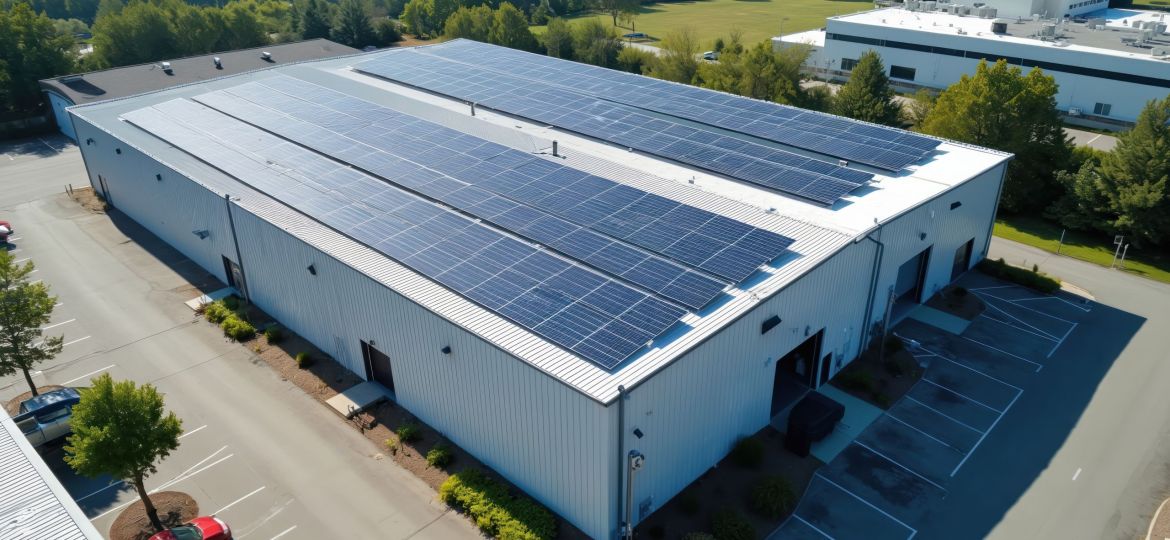
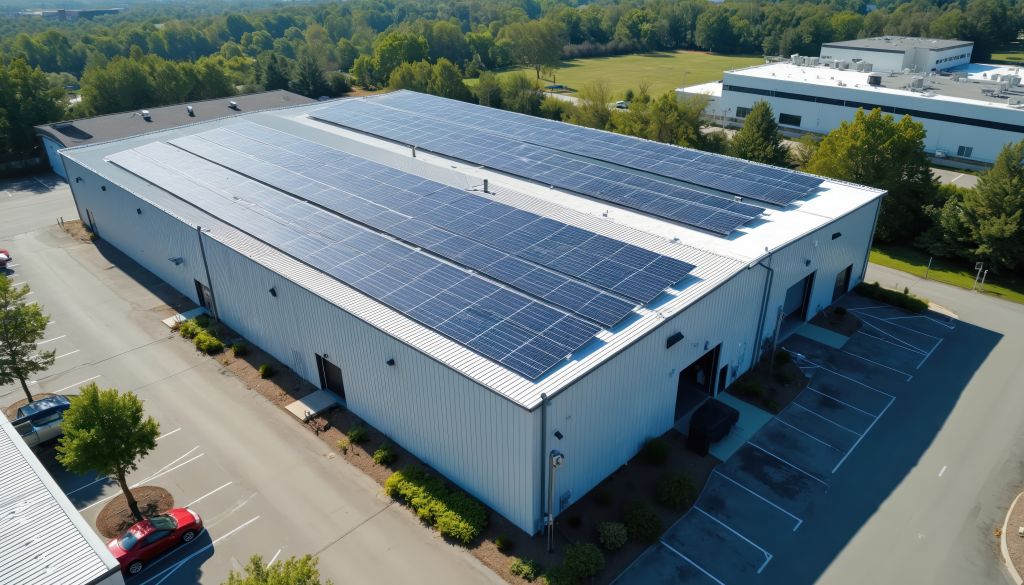
Rooftop solar is common for warehouses, big-box retail, and office parks with large flat or low-slope roofs. Sunprise evaluates decking condition, load paths, and penetration details before finalizing layout—review Lutz commercial solar installation examples when evaluating system scale. If a roof replacement is planned, coordinating solar with roofing work may reduce total project disruption—see our Tampa roof replacement project for documented local work.
Ground-mount arrays suit campuses with open land, municipal facilities, and industrial sites where roof area is limited. These systems offer flexible tilt and orientation when shading or roof obstacles would compromise production estimates.
Solar carports combine covered parking with generation—popular for retail, hospitality, and employee lots in Tampa, Orlando, and Miami metro areas. They may also improve customer and staff comfort while adding visible sustainability branding.
Furthermore, Commercial Solar Florida applies to manufacturing plants, schools, houses of worship, medical offices, and multi-tenant buildings—provided interconnection and ownership structures are documented early. Sunprise designs each scope around your facility’s usage profile rather than a one-size template.
Additionally, mixed-use properties may combine rooftop zones with ground arrays near loading docks or retention areas. In those cases, trenching paths, fire department access, and drainage must be planned before equipment arrives on site. Consequently, early civil and electrical coordination prevents costly redesigns mid-project.
Meanwhile, businesses evaluating battery storage should treat it as a separate engineering decision. Storage may support backup or peak shaving in specific scenarios, but sizing depends on code, utility rules, and operational goals. Sunprise can discuss integrated options during commercial planning when they align with your facility strategy.
The Commercial Solar Florida Installation Process
Transitioning your business to solar should feel clear, structured, and fully supported from start to finish. Therefore, Sunprise follows a documented process that keeps engineering, permitting, and construction under one accountable team.
01 — Evaluate Your Facility's Energy Profile
The first step is understanding how your building uses power throughout the day. We review interval data, demand patterns, and future expansion plans. Additionally, this assessment identifies whether Commercial Solar Florida production aligns with your highest-cost usage windows.
02 — Conduct a Site and Structural Assessment
Every commercial property is unique. Our team inspects roof or land conditions, structural capacity, electrical service size, and shading. Furthermore, we document code requirements for wind uplift and fire setbacks before design begins.
03 — Engineering, Design, and Financial Modeling
Once the site is approved, designers create a custom Commercial Solar Florida configuration with production estimates, equipment specifications, and interconnection plans. Meanwhile, we summarize incentive options that may apply—subject to eligibility—and outline financing paths for qualified businesses.
04 — Professional Installation and Commissioning
Licensed in-house crews handle mounting, electrical integration, inspections, and utility approval. Consequently, you receive a commissioned system with as-built documentation and monitoring setup. Most commercial installations take 4–12 semanas after engineering and permits are complete; larger scopes may require additional time.
Furthermore, Sunprise schedules tie-ins and shutdown windows with your operations team to limit disruption to production, retail hours, or tenant access. Safety fencing, roof access control, and daily cleanup are standard on active commercial sites. Additionally, final commissioning includes verification that monitoring, labeling, and shutdown procedures meet AHJ and utility requirements before the system is placed in service.
Incentives, Tax Credits, and Financing for Commercial Solar Florida
Commerciales may qualify for federal investment tax credits, accelerated depreciation (MACRS), and local or utility programs depending on location and eligibility. Programs change over time—see our 2026 solar guide for business owners y net metering vs net billing guide. Review current options via the Departamento de Energía de EE. UU. y DSIRE. Sunprise resume las opciones disponibles durante la fase de propuesta; la elegibilidad no está garantizada.
Additionally, Commercial Solar Florida projects should be modeled with realistic production assumptions—not inflated savings claims. Tax treatment depends on your organization’s structure; consult a qualified tax professional before relying on credit estimates.
Financing options may be available for qualified businesses. Subject to credit approval. Sunprise does not guarantee approval terms or rates. Therefore, compare cash purchase, loan, and lease structures based on your balance-sheet goals and project timeline.
Furthermore, verify any contractor’s Florida licenses through FL DBPR before signing contracts. Licensed electrical and construction credentials protect your business from unpermitted work and inspection failures.
Meanwhile, some utilities offer limited commercial rebate or interconnection programs that change without notice. Therefore, incentive summaries in a proposal should include effective dates and note that final eligibility is determined by governing agencies—not the installer. In addition, property owners with triple-net leases should confirm who holds interconnection rights and who benefits from bill credits before construction begins.
Commercial Solar Florida Serving Tampa, Orlando, Miami, Brandon, and Clearwater
Tampa Bay: Tampa, Brandon, and Clearwater
Tampa Bay businesses—from Westshore office towers to Brandon industrial parks and Clearwater retail corridors—often face strong afternoon cooling loads. Commercial Solar Florida may help offset those peaks when arrays are sized to match interval usage. Sunprise coordinates Hillsborough and Pinellas permitting internally, which may shorten approval cycles compared to out-of-area installers unfamiliar with local AHJ requirements. Additionally, hurricane-rated mounting and wind-load engineering are standard on Gulf Coast scopes.
Orlando and Central Florida
Central Florida warehouses, theme-park suppliers, and suburban office campuses frequently operate on flat roofs with ample exposure. Commercial Solar Florida designs for Orlando-area utilities and county inspection processes. Furthermore, logistics and distribution centers with extended daytime hours may see stronger alignment between production and load—though savings still depend on tariff details and system size.
Miami and South Florida
South Florida commercial facilities—from Miami-Dade industrial sites to Broward retail—often navigate higher demand charges and strict wind-code requirements. Commercial Solar Florida installations in this region require robust structural review and quality electrical integration. Sunprise plans scopes with hurricane resilience and long-term maintainability in mind. Meanwhile, visible carport or rooftop arrays may support brand-level sustainability messaging for customer-facing businesses.
Why Sunprise Is the Better Commercial Solar Florida Partner
Choosing an installer is choosing who will stand behind engineering, permits, and construction years after the sale call ends. Sunprise operates as a licensed, insured Florida contractor with in-house crews—not a subcontractor broker that hands your project to the lowest bidder.
In-house construction teams. Roofing, electrical, and solar scopes stay under one roof. Consequently, you avoid “subcontractor roulette” and disconnected accountability common in solar-only sales models.
NABCEP-certified expertise. Sunprise holds NABCEP PV certification (PV-082418-01934), reflecting advanced photovoltaic training beyond minimum licensing.
Active Florida credentials. FL Licenses #CVC57137, #EC13010258, #CCC1337075—verifiable through FL DBPR.
Construction coordination. Because Sunprise also delivers tejado and commercial construction, you can align roof replacement, structural repairs, and Commercial Solar Florida installation in one plan.
Transparent process. From energy profiling through commissioning, each phase is documented. Additionally, we set realistic production and savings expectations rather than promising zero-dollar utility bills.
Statewide reach from Oldsmar. Headquartered in Oldsmar, FL, Sunprise serves Tampa, Brandon, Clearwater, Orlando, Miami, and surrounding markets with the same in-house standards.
Therefore, if your organization wants Commercial Solar Florida built by a team that understands Florida codes, commercial construction, and long-term asset performance, start with a Sunprise Commercial Solar consultation.
Additionally, Sunprise clients benefit from a single point of contact across site assessment, permit submission, installation, and post-commissioning support. In contrast to national solar call centers that vanish after contract signing, our Oldsmar-based team remains accountable for workmanship and documentation. Furthermore, combining solar with roofing or structural upgrades through one contractor may reduce mobilization costs and warranty gaps when both scopes are planned together.
Moreover, businesses in Tampa, Brandon, Clearwater, Orlando, and Miami receive the same engineering standards—whether the project is a single retail site or a multi-location portfolio review. Consequently, facility managers can align capital planning across regions without juggling unrelated vendors.
Commercial Solar Florida FAQ
Solar comercial puede compensar una parte del consumo de energía diurna de una instalación, cuando las tarifas de servicios públicos y los cargos por demanda suelen ser más altos. Al generar energía en el sitio, muchas empresas obtienen gastos mensuales más predecibles. Los ahorros reales varían según el uso, el tamaño del sistema y las tarifas de los servicios públicos.
La mayoría de las instalaciones comerciales pueden beneficiarse de la energía solar comercial, incluyendo almacenes, centros comerciales, edificios de oficinas, plantas de fabricación, escuelas y propiedades de múltiples unidades. Si el edificio tiene espacio utilizable en el techo o terreno abierto, generalmente se puede diseñar un sistema que se ajuste al sitio.
Los plazos varían según el tamaño del proyecto, los requisitos de permisos y la coordinación de servicios públicos. La mayoría de las instalaciones comerciales tardan 4–12 semanas una vez completada la ingeniería y las aprobaciones. Los sistemas más grandes pueden requerir tiempo adicional para la revisión estructural o actualizaciones eléctricas.
Commerciales may qualify for federal tax credits, accelerated depreciation (MACRS), local incentives, and utility programs depending on location and eligibility. Programs change over time—see our 2026 solar guide for business owners y net metering vs net billing guide. Review current options via the Departamento de Energía de EE. UU. y DSIRE. Sunprise resume las opciones disponibles durante la fase de propuesta; la elegibilidad no está garantizada.
La mayoría de las instalaciones se completan con una interrupción mínima. El trabajo se realiza típicamente en el techo o en áreas designadas en tierra, y las conexiones eléctricas se programan para evitar interferir con el horario comercial cuando sea posible. Nuestro equipo se coordina con su personal de operaciones para mantener la seguridad y la continuidad.
Los paneles solares comerciales suelen tener una clasificación de 25–30+ años de rendimiento, con inversores y otros componentes seleccionados para confiabilidad a largo plazo. El mantenimiento y monitoreo rutinarios ayudan a los sistemas a operar eficientemente durante su vida útil.
Sí. La energía solar comercial es una forma medible de reducir la huella de carbono y demostrar liderazgo ambiental. Muchas organizaciones utilizan la adopción de energía solar para respaldar informes ESG, la certificación LEED y los compromisos de sostenibilidad corporativa.
Si el techo no es adecuado debido a sombras, limitaciones estructurales o diseño, alternativas como Sistemas de marquesina o conjuntos en montaje terrestre puede estar disponible. Sunprise evalúa las opciones de instalación para determinar la mejor opción para su propiedad.
Ready to evaluate on-site generation for your facility? Sunprise provides site reviews, engineering, and installation for Florida businesses. Request a Commercial Solar analysis to receive a scope tailored to your building, usage, and location.
 English
  Spanish